[ad_1]
Saving for a house, paying down their debt, saving a little something extra for the first time; as the federal student loan payment pause winds down, borrowers are lamenting the break from the monthly bills that allowed them to achieve their other financial—and personal—goals.
“I’ve thought about it over the past few years as a race against the clock, how much can I pile up before this thing restarts,” says Asher Mitchell, who has $99,000 in student loans, mostly from law school. “I’m happy it’s lasted as long as it has, I think everyone in my position would say they’re grateful.”
The moratorium on federal student loan payments and interest accrual was instituted in March 2020 at the start of the COVID-19 pandemic and extended multiple times by the administrations of both former President Donald Trump and President Joe Biden.
Given today’s high cost-of-living, some borrowers have been hoping it would be extended once again. But a provision in the debt ceiling legislation passed Wednesday by the House of Representatives quashes that dream, codifying its end once and for all. Assuming Biden signs the legislation into law, payments will restart on Aug. 30.
And while all borrowers benefitted from the pause, millennials—that unlucky group of 27 to 42-year-olds—stand to lose one of the first breaks they’ve received since graduating into the Great Recession, facing disproportionately harsh economic damages during COVID-19, and taking on more debt than the generations before them, all as inflation drives the cost-of-living higher and higher.
The once-in-a-lifetime pause has gone on so long, many borrowers, including Mitchell, have never made a payment on their debt. Since he graduated from law school in 2021, he and his wife have saved around $50,000 in a high yield savings account. The Missouri resident plans to put the majority of that toward his student loans before interest starts accruing again, and, hopefully, pay off the balance completely by the end of the year. Mitchell, 28, estimates he’s saved $20,000 in interest alone.

Courtesy of Asher Mitchell
“This is the baby I’ve been raising for a few years, and now I have to let it go,” says Mitchell of his savings account. “It’s been great to save up with no consequences, it feels like I’ve gotten away with something.”
Though Mitchell and his wife make good money as lawyers, he says they’ve put everything extra into a savings account to pay off his debt faster. They are not currently saving for a house or other long-term goals, or considering having children; once the debt is gone, they will reevaluate.
“Those things eat at you,” he says. “But to have this kind of total pause and 0% interest rate has been a godsend.”
‘I got free years toward forgiveness’
For Addison, who asked for his last name to be withheld to protect his privacy, the payment pause has enabled him and his wife to pay off their two car loans, buy $10,000-worth of high-interest I-bonds, and save significantly in a 529 account to put toward her student loans. Addison, who works for the government, received Public Service Loan Forgiveness last year, wiping out the remainder of his $36,000 loan balance; because of the pause, he made 99 of the required 120 monthly payments to receive forgiveness through the program (the months of the pause count toward forgiveness programs).
“I was elated,” Addison, 39, says of receiving PSLF. “I got years free, essentially, toward forgiveness. Being able to build up that savings makes me feel better about everything going on.”
When payments resume, Addison and his wife, who live in West Virginia, will need to redirect around $550 per month toward her debt. They are already planning for how the bill will necessitate changes in their budget and savings habits. “With the cost-of-living, it’s going to be very hard,” he says.
Other borrowers have told Fortune the pause allowed them to make significant in-roads on paying down their debt, saving for homes, and generally improved their financial outlook. Already, other types of consumer debt are growing as inflation hammers household budgets; economists warn of a “student loan cliff” that will hurt not only individuals but the entire economy once payments resume and borrowers must find an extra $400, on average, to pay their bills.
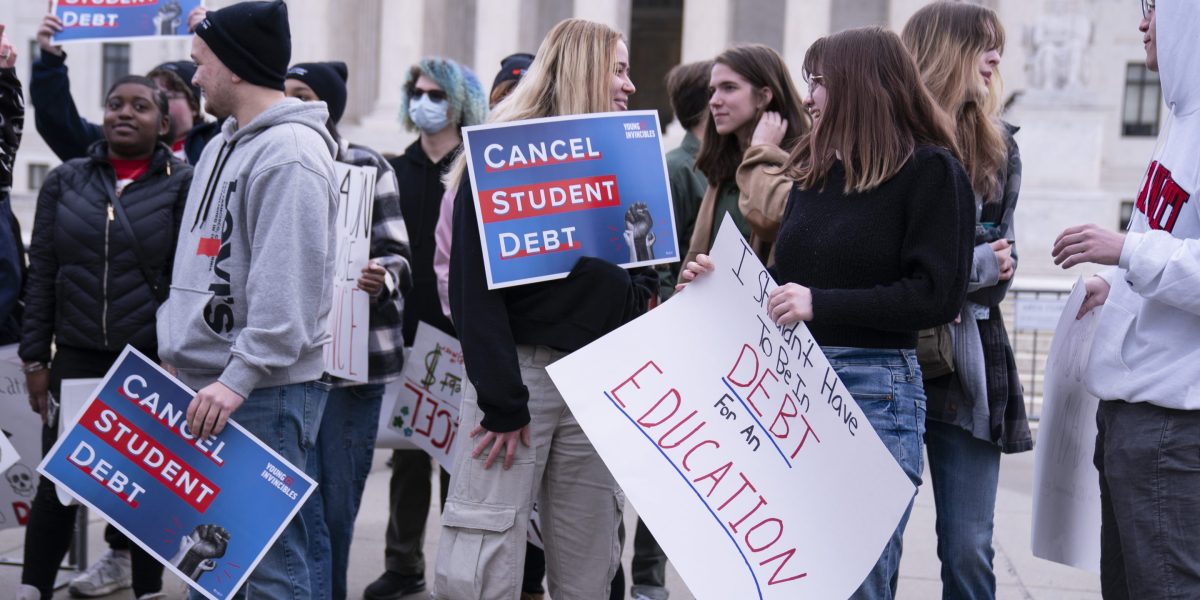
Some borrowers are still hopeful that the U.S. Supreme Court will uphold Biden’s plan to forgive up to $20,000 in federal loans for most borrowers. But Addison and Mitchell aren’t banking on it.
“I’m not optimistic about what the Supreme Court is going to do,” says Mitchell. “As far as I can tell, it’s been a momentary three-year blip in time.”
[ad_2]
Source link


